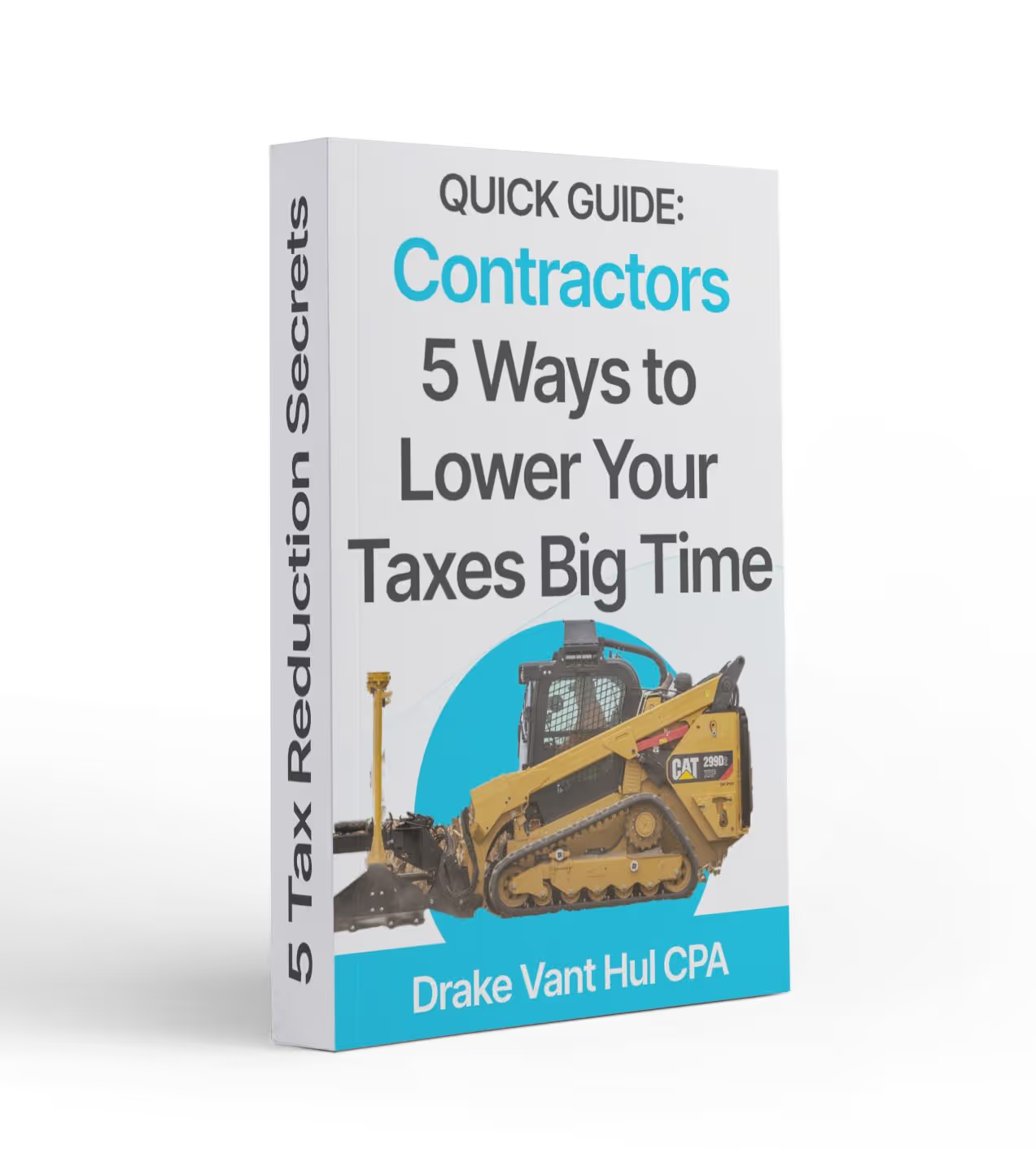
You didn't get into construction to spend nights buried in spreadsheets and tax forms. You got into it to build things, solve problems, and create something you're proud of. But here's the reality most contractors face: without expert financial guidance, you're working harder than you need to while paying more in taxes than you should.
Most accounting firms treat contractors like every other small business. They do your taxes once a year, hand you a bill, and send you on your way. That's not accounting—that's compliance work dressed up as professional service. It's why so many contractors in Des Moines earn solid revenue but struggle to understand where the money actually goes.
At Performance Financial, we've built our entire practice around three things that actually move the needle for construction companies: expert accounting services that give you financial clarity, proactive advisory guidance that helps you make better decisions, and aggressive tax planning that keeps more money in your business instead of sending it to the IRS.
Let's talk about what that actually means for your construction business.
Expert Accounting Services: Know Your Numbers, Make Better Decisions
Your bookkeeping system should answer one critical question: which jobs are actually making you money? Most contractors can't answer that question because their bookkeeper treats them like a retail store instead of a project-based business.
We provide expert accounting services designed specifically for how construction companies operate. This means proper job costing that tracks every dollar against specific projects, financial reports that show you which types of jobs generate the best margins, and monthly financial statements you can actually use to make management decisions instead of just filing away.
Consider how Partners Restoration approaches their project accounting. They maintain detailed cost tracking across multiple project types, from emergency water damage restoration to large commercial buildouts. That level of financial clarity doesn't happen by accident—it requires accounting systems specifically designed for project-based businesses.
The construction accounting firms that actually understand your industry provide more than data entry. Firms like Makh Accounting in Houston and Financially Faithful in Oklahoma City have built their practices around construction-specific financial reporting. They understand concepts like work-in-progress schedules, retention holdbacks, and percentage-of-completion accounting because they work with contractors every single day.
When your accounting is structured correctly, you stop guessing about project profitability and start making decisions based on actual financial data. You know which project types to pursue more aggressively, which expenses are eating into margins, and where you need to tighten up pricing.
That's what expert accounting services should deliver. Not just compliance, but clarity. Not just historical data, but actionable intelligence that helps you build a more profitable business.
Advisory Services: Get Answers to the Questions That Actually Matter
Here's where most accounting firms fail contractors: they only show up when you call them with a problem. That's reactive service, and it keeps you stuck in crisis mode instead of building toward growth.
Our advisory services help you navigate the operational and financial questions that come up when you're actually running a construction business. Questions like: Should we bring payroll in-house or keep outsourcing it? Is it time to upgrade that equipment or keep running what we have? Can we afford to hire another project manager? How do we structure this partnership with the electrical sub we've been working with?
These aren't tax questions. They're business questions that require someone who understands both the financial implications and the operational realities of running a construction company.
Take equipment decisions as an example. Companies like Ground Tech in Minnesota make significant capital equipment investments regularly. Whether to buy, lease, or rent specialized machinery involves analyzing cash flow timing, understanding depreciation strategies, evaluating utilization rates, and considering how each option impacts borrowing capacity. A good advisor doesn't just tell you the tax answer—they help you think through the complete business equation.
Or consider the payroll question. Bettencourt Construction manages multiple crews across different project types. Setting up effective payroll systems for construction requires understanding prevailing wage requirements, certified payroll reporting, workers' compensation classifications, and how to properly allocate labor costs to specific jobs. These operational details directly impact financial results, which is why advisory support matters.
When you're evaluating whether to take on a larger commercial project, you need someone who can help you analyze whether your bonding capacity can handle it, if your cash flow can manage the longer payment cycles, and how it fits into your overall business strategy. Cascade Concrete Coatings didn't scale from residential driveways to commercial industrial floors by guessing—they made strategic decisions supported by solid financial guidance.
Advisory services bridge the gap between knowing your numbers and knowing what to do with them. We help you work through the decisions that determine whether your construction business just survives or actually thrives. Firms like BluPrint CPA in Charlotte and West CPA Group in St. Louis have built strong reputations by providing this level of operational support to contractors.
This is where strategic guidance separates average construction accounting firms from those that genuinely understand your business. You need someone who's seen these situations play out hundreds of times across different contractors and can help you navigate them successfully.
Expert Tax Planning: Stop Leaving Money on the Table
Let's get brutally honest about taxes: if you're only talking to your accountant in March and April, you're overpaying. Tax planning isn't something that happens when you file your return—it's a year-round strategy that requires understanding your business structure, timing decisions strategically, and implementing tactics that most general accountants never mention.
This is where most contractors lose significant money they never even know about. They pay their "fair share" plus tens of thousands in completely unnecessary additional taxes because nobody ever showed them there was a better way.
Our tax reduction planning focuses on three areas most contractors completely overlook: entity structure optimization, strategic timing of income and expenses, and maximizing construction-specific deductions most accountants don't understand.
Entity structure alone can save contractors $15,000 to $30,000 annually. Most contractors operate as sole proprietors or single-member LLCs, which means they're paying self-employment tax on every dollar of profit. Converting to an S-Corporation structure when you reach certain profit thresholds can immediately cut your tax bill by splitting income between reasonable salary and distributions.
Consider typical scenarios: a general contractor generating $200,000 in net profit as a sole proprietor pays roughly $30,000 in self-employment taxes alone. That same contractor structured as an S-Corp with an $80,000 salary and $120,000 in distributions pays around $12,000 in self-employment taxes—an immediate $18,000 savings. Companies like Homes by Moderno and Country Creek Builders understand these structures matter.
Then there's equipment depreciation strategy. Section 179 allows you to immediately deduct equipment purchases rather than depreciating them over five to seven years, but most contractors don't understand how to strategically time these purchases to maximize tax benefits. Buy that excavator in December instead of January, and you might save $15,000 in taxes for the current year while also getting a full year of use the following year.
Retirement planning offers another massive opportunity most contractors miss. SEP IRAs and Solo 401(k)s allow you to defer significant income—up to $69,000 for 2024—while building long-term wealth. Legacy Painting in Virginia and Davis Contracting in Omaha both demonstrate how successful contractors use tax strategy tools.
Construction-specific deductions create another layer of savings. Things like work truck modifications, tool replacements, safety equipment, specialty insurance, continuing education for certifications, and even the percentage of your phone and home office used for business. Fredrickson Masonry tracks these expenses meticulously, understanding that consistent attention to deductible expenses adds up to thousands in annual tax savings.
Firms specializing in construction tax strategy, like Charter CPA and Financial Breakthrough, have built entire practices around helping contractors implement these strategies. They understand that tax planning for contractors requires industry-specific knowledge that goes far beyond general small business tax preparation.
Here's what separates proactive tax planning from the compliance work most accountants provide: we're looking ahead twelve months, analyzing your projected income and expenses, identifying opportunities to accelerate deductions or defer income, evaluating entity structure changes, and implementing strategies throughout the year instead of scrambling in December.
When we put together a tax plan, we're not just trying to reduce your current year tax bill—we're building a multi-year strategy that compounds savings while ensuring you're never surprised by a massive tax liability.
Why This Approach Works for Des Moines Contractors
Construction companies in Des Moines and across the Midwest face specific financial challenges that generic accounting firms don't understand. The seasonal nature of work in Iowa creates cash flow timing issues. The competitive bidding environment means thin margins on many projects. The complexity of managing multiple jobs simultaneously requires sophisticated financial tracking.
Whether you're a general contractor like New Spaces managing custom home builds, a specialty contractor like IBS Coating focused on epoxy flooring, or a commercial builder like Gerl Construction, you need financial partners who understand these dynamics.
We've worked with custom home builders throughout the Des Moines metro—from Johnston to West Des Moines to Ankeny—and we've seen what separates profitable contractors from those constantly struggling with cash flow.
The difference isn't how hard you work. It's having financial systems that give you clarity about where you actually make money, advisory support that helps you navigate growth decisions, and tax strategies that keep more profit in your business.
Other construction-focused accounting firms across the Midwest, including Passageway Financial in Minnesota and Complete Balance CPA, understand this same principle: contractors need specialized financial support, not generic small business accounting.
Companies like Plan Pools, Minnesota Landscapes, and Charter Home Renovation didn't build successful contracting businesses by accident. They invested in proper financial systems, got proactive about tax planning, and worked with advisors who understood their specific challenges.
Take the Next Step
If you're ready to stop overpaying on taxes and start getting real financial clarity about your construction business, we should talk. We've built our practice specifically around helping contractors like you implement these three core services: expert accounting that shows you where you make money, advisory support that helps you make better decisions, and tax planning that actually reduces what you send to the IRS.
Visit our website at performancefinancialllc.com or follow us on Facebook and Instagram to learn more. We'd love to schedule a Tax Reduction Analysis to see exactly where you could be saving money and how we can help you build a more profitable construction business.
Let us show you what's possible when you work with CPAs who actually understand the construction industry.
Schedule a Tax & Accounting Analysis Now
Step 1 - Fill out the form below.
Step 2 - Select a time.
Step 3 - Provide documents.