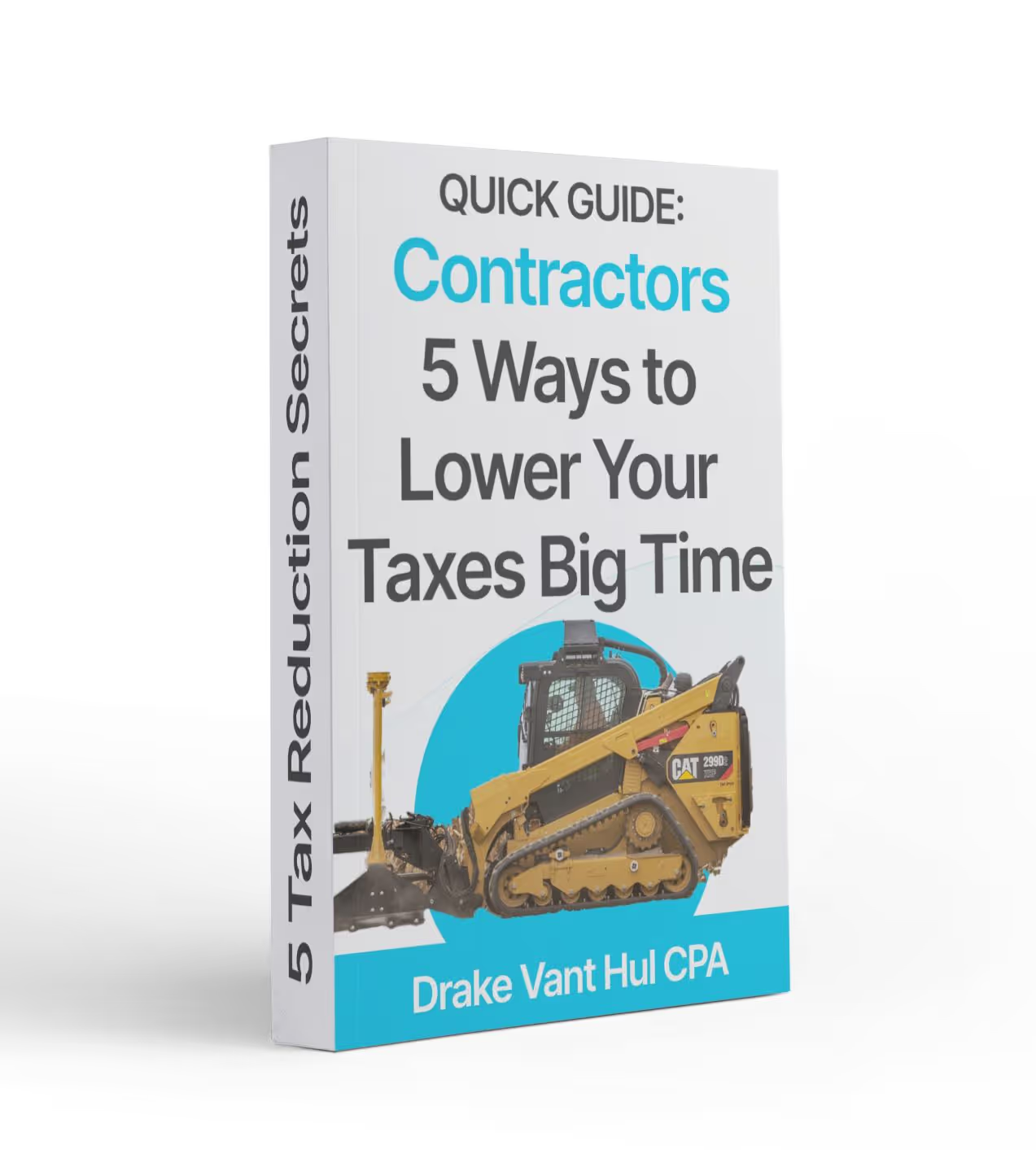
You're running a booming tile business. Your installations are beautiful, clients love your work, and you're busier than ever. But here's the brutal truth: being busy doesn't mean you're profitable. Most tile contractors leave tens of thousands of dollars on the table every year because they're missing the right tax strategies, financial systems, and growth planning.
My name is Drake van Hall, and I'm a CPA who owns Performance Financial. We work with tile contractors all across the United States, specifically helping them with their tax prep, accounting, and long-term business advisory. What we really do is put more money inside your pockets. We help you increase your profits by understanding your costs better. We help you plan for taxes so they're not this big fear come the end of the year.
We speak to you from an entrepreneur-to-entrepreneur's standpoint. We're not using fancy words and jargon. We're available when you need us. If you're looking for somebody that specializes in what you are doing, this guide will show you exactly how to take your tile business to its top performance.
The Tile Contractor's Profit Problem
Here's what happens to most tile contractors: You install beautiful ceramic tile, porcelain tile, natural stone, and specialty surfaces. You bid jobs competitively, work long hours, manage crews, deal with material suppliers, and handle difficult job sites. At the end of the year, you look at your bank account and wonder where all the money went.
The problem isn't your craftsmanship. The problem is that nobody taught you how to run a tile business as a profitable enterprise. You're focused on completing jobs, but you're not focused on maximizing profitability and minimizing taxes. That's where specialized construction accounting changes everything.
#1 Tile Contractor Growth Strategy: Maximize an S-Corp to Slash Self-Employment Taxes
What's the Biggest Tax Deduction for Tile Contractors?
If you're operating your tile business as a sole proprietorship or standard LLC, you're getting destroyed by self-employment taxes. Every dollar you earn gets hit with 15.3% in self-employment taxes before you even think about income taxes. For a tile contractor making $150,000 in net income, that's $22,950 in self-employment taxes alone.
Should You Convert to an S-Corp?
An S-Corporation election is the single most powerful tax strategy available to profitable tile contractors. When structured correctly, an S-Corp allows you to split your income between reasonable salary and distributions. Only the salary portion gets hit with the 15.3% self-employment tax.
Let's use a real example: A tile contractor earning $150,000 net income pays $22,950 in self-employment taxes as a sole proprietor. Convert to an S-Corp, set a reasonable salary of $75,000, and now you only pay $11,475 in self-employment taxes. That's an immediate $11,475 tax savings every single year.
Is Your S-Corp Maximized for Tax Reduction?
Here's where most tile contractors make mistakes: They convert to an S-Corp but don't maximize it properly. There are critical tensions between salary decisions, distribution timing, qualified business income deductions, and retirement plan contributions. Getting these wrong can trigger audits or leave money on the table.
The IRS provides specific guidance on S-Corporation compensation requirements. Your salary must be "reasonable" for the work you perform. For tile installation contractors, this typically means analyzing industry standards, your role in the business, and comparable salaries.
Don't Let a Lazy Accountant Cost You Thousands
Most generic accountants don't provide proactive S-Corp planning throughout the year. They file your 1120S tax return and call it done. They don't help you optimize the salary-distribution split. They don't adjust strategies as your business grows. They don't integrate S-Corp planning with retirement contributions and the qualified business income deduction.
At Performance Financial, we specialize in aggressive tax reduction planning for tile contractors. We analyze your specific situation, determine the optimal S-Corp structure, and make adjustments throughout the year to maximize your tax savings while staying compliant.
Real-World Example: Minnesota General Contractor Maximizes Tax Strategy
Take a look at how Partners Construction in Minnesota has built their business with proper financial systems. While they focus on general contracting, their approach to professional business operations demonstrates the level of sophistication tile contractors need. They understand that growth requires more than great installations—it requires strategic financial management.
Florida Pool Builder Shows Strategic Tax Planning Value
Plan Pools in Minnesota demonstrates how specialty contractors benefit from professional accounting services. Pool installation shares many similarities with tile work—project-based revenue, material management, crew coordination, and seasonal variations. Their professional approach to business operations reflects the financial sophistication that drives profitability.
Pennsylvania Contractor Demonstrates Professional Systems
ADF Philly in Pennsylvania shows how contractors can build scalable businesses with proper financial foundations. Their structured approach to project management and business operations exemplifies what tile contractors should aspire to when building sustainable, profitable businesses.
How Performance Financial Helps Tile Contractors Maximize S-Corp Benefits
We handle everything: converting your entity to an S-Corp using IRS Form 2553, setting up proper payroll systems, determining your optimal salary level, managing quarterly estimated tax payments, and integrating S-Corp strategy with retirement planning.
Ready to stop overpaying in taxes? Book a Tax Reduction Analysis and we'll show you exactly how much an S-Corp election could save you.
#2 Tile Contractor Growth Strategy: Implement Proper Job Costing Systems
Why Most Tile Contractors Don't Know Their True Profitability
You think you know which jobs make money. You bid a bathroom remodel at $8,500, complete the installation, get paid, and move on to the next job. But did that job actually make money? When you factor in labor costs, material waste, equipment usage, vehicle expenses, insurance allocation, and your time, many tile jobs that seem profitable actually lose money.
The Job Costing Imperative for Tile Installation Businesses
Proper job costing for construction contractors transforms your business from guessing to knowing. You need to track costs by project: direct labor hours, material costs including waste, subcontractor expenses, equipment usage, vehicle costs, and overhead allocation.
Our clients who implement job costing systems discover surprising insights. That quick kitchen backsplash you bid at $2,500? Once you track actual labor hours, material waste, and two trips for forgotten materials, you might be making $15 per hour. Meanwhile, that large commercial lobby installation you worried about? It's your most profitable job because of efficiency at scale.
How Performance Financial Implements Job Costing for Tile Contractors
We integrate job costing directly into your bookkeeping system. Every expense gets coded to specific jobs. Every material purchase gets allocated. Every hour worked gets tracked. At the end of each job, you get a complete profitability analysis showing exactly what you made and where costs exceeded estimates.
This information is pure gold for your business. You can identify which types of jobs are most profitable. You can refine your bidding process. You can eliminate unprofitable service lines. You can optimize crew efficiency. You can build your business around high-margin work instead of staying busy with low-profit jobs.
Minnesota Demolition Company Shows Project-Based Accounting
DMS Demolition demonstrates how project-based contractors benefit from sophisticated financial tracking. While they specialize in demolition, the project accounting principles apply directly to tile installation work. Understanding project-level profitability drives better business decisions.
Custom Home Builder Exemplifies Financial Sophistication
Homes by Moderno shows the level of financial management that separates thriving contractors from struggling ones. Their approach to project management and cost control reflects the systems tile contractors need to implement for sustainable growth and profitability.
Book Your Tax & Accounting Analysis Today
Don't spend another year wondering which jobs make money. Contact Performance Financial and we'll implement job costing systems that transform your tile business profitability.
#3 Tile Contractor Growth Strategy: Maximize Vehicle and Equipment Tax Deductions
The Section 179 Deduction Opportunity for Tile Contractors
Tile contractors invest heavily in vehicles and equipment: work trucks, tile saws, wet saws, mixers, scaffolding, laser levels, and specialized tools. Under Section 179, you can immediately deduct the full purchase price of qualifying equipment and vehicles in the year of purchase, rather than depreciating them over several years.
For 2025, the Section 179 deduction limit is substantial, allowing tile contractors to write off significant equipment purchases. This creates immediate tax savings and improves cash flow. Instead of depreciating that $45,000 work truck over five years, you can deduct the entire amount this year.
Bonus Depreciation for Heavy Tile Installation Equipment
In addition to Section 179, bonus depreciation allows you to deduct additional amounts for qualifying property. For tile contractors purchasing heavy equipment like commercial mixers, large format tile cutters, or specialized vehicles, this creates substantial tax savings.
The key is strategic timing. If you're having a profitable year, purchasing equipment before December 31st can significantly reduce your tax liability. But you need proper planning to ensure the purchases make business sense and qualify for maximum deductions.
Vehicle Deductions: Standard Mileage vs. Actual Expenses
Tile contractors drive constantly: to job sites, material suppliers, client meetings, and equipment rentals. You can deduct vehicle expenses using either the standard mileage rate or actual expenses method. For contractors with expensive work trucks, the actual expenses method often provides larger deductions.
Actual expenses include fuel, insurance, repairs, maintenance, tires, registration, loan interest, and depreciation. For a tile contractor putting 25,000 business miles annually on a $50,000 truck, actual expenses typically exceed standard mileage deductions by thousands of dollars.
Roofing Contractor Demonstrates Equipment Investment Strategy
Stormmaster Roofing shows how specialty contractors can invest in quality equipment while maximizing tax benefits. Their professional approach to business operations and equipment management reflects the strategic thinking that builds profitable contracting businesses.
Virginia Contractor Shows Professional Operations
Legacy Painting 757 in Virginia demonstrates how contractors can build professional operations with proper financial systems. Their structured approach to business growth and management exemplifies what tile contractors should implement for long-term success.
How We Help Tile Contractors Maximize Equipment Deductions
At Performance Financial, we help you plan equipment purchases strategically. We analyze your projected income, calculate tax impacts, and advise on optimal timing. We ensure you meet all IRS requirements for Section 179 deductions and bonus depreciation. We track vehicle usage and maximize your deductions using the most beneficial method.
#4 Tile Contractor Growth Strategy: Implement Retirement Plans for Tax Savings
Why Tile Contractors Need Small Business Retirement Plans
Most tile contractors think retirement plans are just for employees at big corporations. The truth is, small business retirement plans are one of the most powerful tax reduction strategies available. The government incentivizes retirement savings through massive tax deductions for contributions.
For an S-Corp tile contractor, retirement plan contributions come off the top—reducing both your taxable income and self-employment taxes. A tile contractor making $150,000 could potentially contribute $66,000 or more to qualified retirement plans, creating over $20,000 in tax savings while building wealth for the future.
Solo 401(k) Plans for Owner-Only Tile Businesses
If you operate your tile business without full-time employees, a Solo 401(k) offers maximum contribution flexibility. You can contribute as both employee and employer, allowing for much larger contributions than traditional IRAs.
For 2025, you can contribute up to $23,000 as an employee deferral (or $30,500 if age 50+), plus up to 25% of your W-2 compensation as an employer contribution, with a total contribution limit of $69,000 (or $76,500 if age 50+).
SEP IRA and Simple IRA Options
If you have employees, SEP IRAs and SIMPLE IRAs provide excellent retirement savings options. SEP IRAs allow you to contribute up to 25% of compensation for yourself and eligible employees. SIMPLE IRAs allow employee deferrals plus employer matching or contributions.
The key is integrating retirement plan strategy with your S-Corp salary decisions. Your retirement contribution limits are based on your W-2 salary, creating important planning considerations when determining your salary-distribution split.
Defined Benefit Plans for High-Income Tile Contractors
For tile contractors with consistently high income (over $200,000) who want to supercharge retirement savings, defined benefit plans allow contributions of $100,000 or more annually. These plans work best for contractors in their 50s who want to catch up on retirement savings while creating massive tax deductions.
Texas Builder Demonstrates Business Sophistication
Garvin Homes in Texas shows the level of professional operations that drive long-term business success. Their structured approach to business management reflects the financial sophistication that allows contractors to implement advanced strategies like defined benefit retirement plans.
Performance Financial Retirement Planning for Tile Contractors
We analyze your entire financial picture to determine which retirement plan structure maximizes your tax savings while meeting your retirement goals. We handle all the setup, administration, and compliance requirements. We integrate retirement planning with your S-Corp strategy and overall tax plan.
Schedule your consultation to discover how retirement plan contributions can slash your taxes while building your financial future.
#5 Tile Contractor Growth Strategy: Get Proper Bookkeeping Systems
Why Generic Bookkeeping Fails Tile Contractors
Your cousin's bookkeeper who handles retail stores has no idea how to properly account for tile installation work. Tile contractors need specialized construction accounting that handles: job costing by project, work-in-progress schedules, retention holdbacks, progress billing, equipment depreciation, inventory management for materials, subcontractor payments, and prevailing wage compliance for commercial work.
What Proper Tile Contractor Bookkeeping Includes
Professional bookkeeping for construction contractors goes far beyond entering transactions. We provide: monthly job profitability reports, cash flow forecasting, accounts receivable aging analysis, vendor payment optimization, equipment tracking and depreciation, payroll tax compliance, quarterly tax projections, and strategic financial advising.
Every month you should know: which jobs made money, where you're spending more than projected, which clients owe you money, when bills are due, and what your estimated tax liability will be. You should never be surprised by a tax bill or cash crunch.
The Cost of Bad Bookkeeping for Tile Contractors
Bad bookkeeping costs tile contractors in multiple ways. You miss tax deductions because expenses aren't properly categorized. You bid jobs incorrectly because you don't know actual costs. You face cash crunches because you don't track receivables and payables. You overpay taxes because you don't do quarterly planning. You make poor business decisions because you don't have accurate financial information.
Minnesota Landscape Company Shows Professional Operations
Minnesota Landscapes demonstrates how specialty contractors benefit from professional financial management. While they focus on landscape construction, the accounting principles mirror what tile contractors need—project-based accounting, material tracking, and crew cost analysis.
Charter Home Renovation Shows Contractor Excellence
Charter Home Renovation exemplifies how specialty contractors can build sophisticated businesses with proper systems. Their professional approach to operations and financial management reflects what separates thriving contractors from those barely surviving.
Performance Financial Bookkeeping for Tile Contractors
We provide full-service construction accounting specifically designed for tile contractors. We use QuickBooks or your preferred platform, customized with proper chart of accounts, job costing setup, and contractor-specific tracking. You get monthly financial statements, job profitability analysis, and strategic guidance.
Why Tile Contractors Choose Performance Financial
We're not your typical accounting firm. We specialize in contractor accounting and tax planning because that's all we do. We understand tile installation businesses. We know your challenges: seasonal cash flow variations, material price fluctuations, bid estimation complexities, crew management costs, and competitive pricing pressure.
Our Entrepreneur-to-Entrepreneur Approach
Drake van Hall built Performance Financial with one mission: help contractors like you keep more of what you earn. We don't use fancy jargon. We explain things in plain English. We're available when you need us—not just at tax time, but year-round when questions arise.
What Makes Performance Financial Different
We provide three things most accountants don't: aggressive tax reduction planning throughout the year, specialized construction accounting systems, and strategic business advisory. We proactively look for ways to save you money. We build financial systems that support growth. We help you make better business decisions.
Our Track Record with Trade Contractors
We work with tile contractors, electricians, painters, general contractors, remodelers, and specialty contractors across the United States. Our clients consistently save thousands in taxes while building more profitable, scalable businesses.
Other Accounting Firms Serving Tile Contractors
While Performance Financial specializes in tile contractor accounting in Des Moines and the Midwest, other quality firms serve contractors nationally. Noble Tax Strategies in Florida provides specialized services for flooring contractors including tile installers. West CPA Group in Missouri offers construction accounting services. Passageway Financial in Minnesota works with general contractors and specialty trades.
For tile contractors seeking local expertise, we also recommend exploring accounting firms in Cedar Rapids, Sioux City area accountants, and Dubuque accounting services for contractors throughout Iowa.
Marketing Growth for Your Tile Business
Beyond accounting and taxes, tile contractors need effective marketing to maintain steady work flow. For contractors looking to improve their online presence, Feedbackwrench specializes in contractor marketing and SEO. They help tile installers rank higher in local searches, generate more qualified leads, and build professional websites that convert visitors into customers.
For comprehensive marketing strategy development, check out our guide on Facebook Groups for small business marketing and our insights on local SEO tips for Omaha that apply to contractors in any market.
Ready to Grow Your Tile Business?
You started your tile business to install beautiful work, not to deal with taxes and bookkeeping. But the financial side of your business determines whether you build wealth or just stay busy. The difference between struggling and thriving often comes down to having the right CPA who specializes in contractor businesses.
Performance Financial helps tile contractors across the United States:
- Slash taxes through S-Corp optimization, retirement plans, and strategic deductions
- Increase profitability through job costing and cost analysis systems
- Improve cash flow through professional bookkeeping and financial management
- Scale operations through strategic business advisory and growth planning
- Stay compliant while aggressively minimizing tax liability
Take the Next Step
Stop overpaying in taxes. Stop wondering which jobs make money. Stop dealing with tax surprises. Book a Tax Reduction Analysis with Performance Financial today.
We'll review your tax returns, analyze your business structure, and show you exactly how much money we can save you. Most tile contractors discover savings of $10,000 to $30,000 annually through proper tax planning and S-Corp optimization.
Visit PerformanceFinancialLLC.com or reach out on Facebook and Instagram. We can't wait to help take your tile business to its top performance.
Additional Resources for Tile Contractors
- 5 Tax Hacks for Contractors
- Best Tax Accountants for Construction Contractors
- Common Bookkeeping Mistakes Small Businesses Make
- Self-Employment Taxes: What You Need to Know
- How to Start a Construction Company in Iowa
Whether you're installing ceramic tile in residential bathrooms, porcelain tile in commercial kitchens, natural stone in luxury homes, or specialty tile in custom projects, Performance Financial provides the accounting expertise you need to maximize profitability and minimize taxes.
Don't let another year go by leaving money on the table. Contact us today and discover why tile contractors across the country trust Performance Financial as their CPA and business advisor.
Schedule a Tax & Accounting Analysis Now
Step 1 - Fill out the form below.
Step 2 - Select a time.
Step 3 - Provide documents.