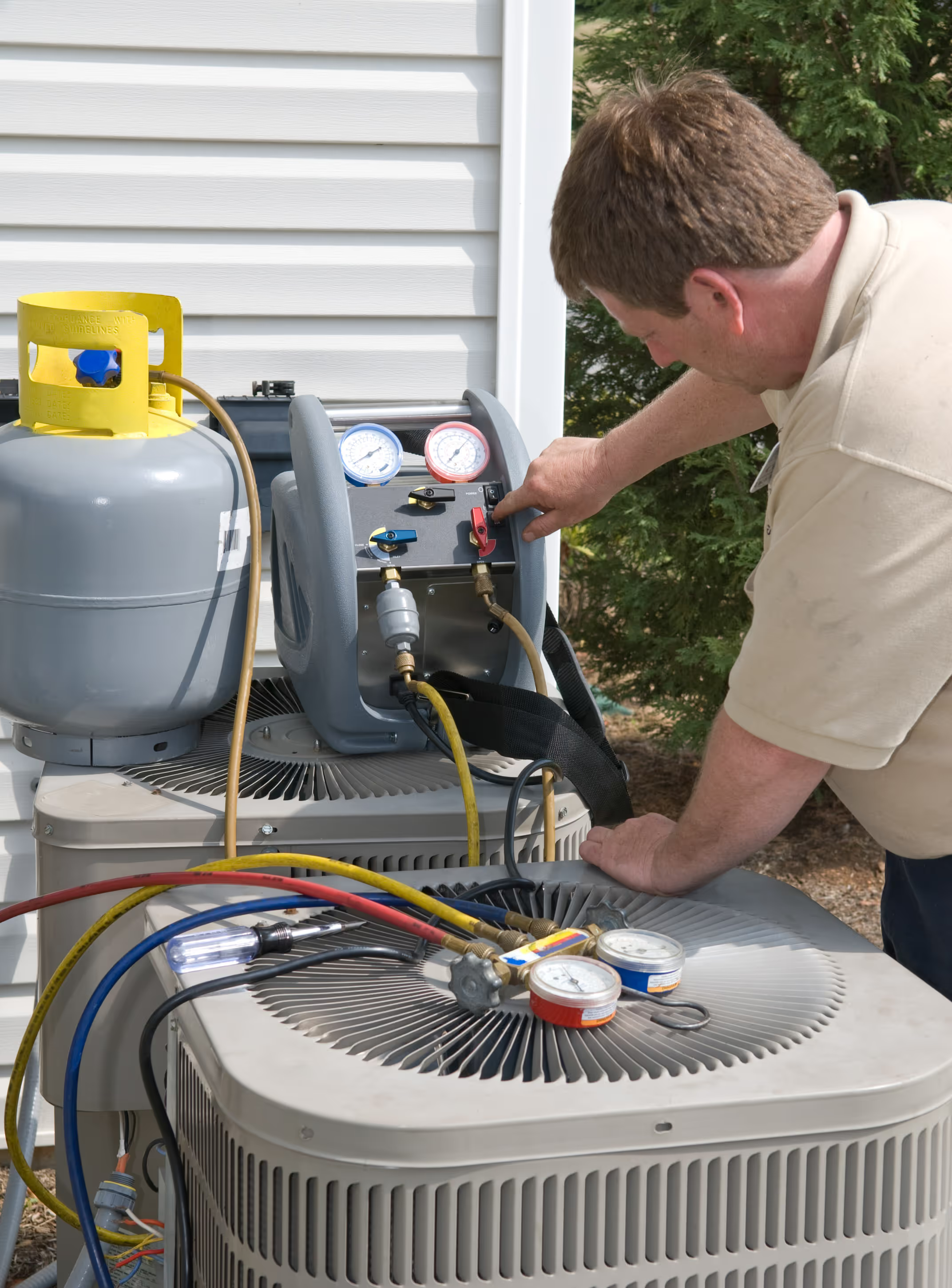
HVAC contractors in Iowa run some of the most capital-intensive small businesses in the trades. Vans, refrigerant recovery equipment, diagnostic tools, rooftop unit installations, ductwork fabrication equipment — the list of assets goes on and on. And every single one of those assets represents a tax deduction that, if handled correctly, can save you five figures or more per year.
The problem is that most HVAC contractors are working with accountants who don't understand the construction and trades industry. They're filing basic returns, missing critical deductions, and leaving their clients exposed to unnecessary tax liability year after year.
We are Performance Financial CPA, Accounting & Tax — a Des Moines CPA firm that specializes in serving HVAC companies, mechanical contractors, and trades businesses across Iowa and the Midwest. We offer aggressive tax reduction planning, construction-specific bookkeeping, S-Corp structuring, and CFO advisory services.
If you want to see exactly how much you're overpaying, book a Tax & Accounting Analysis with our team. We show up with specific numbers, not vague possibilities.
Here are 10 tax hacks that work specifically well for Iowa HVAC contractors.
#1 HVAC Contractor Tax Hack: Structure as an S-Corporation
Stop Paying 15.3% SE Tax on Every Dollar of Profit
If you're an HVAC contractor filing as a sole prop or LLC without an S-Corp election, you're paying self-employment tax on 100% of your net profit. At $150,000–$250,000 in net income — typical for a mid-size HVAC company — that's $22,950–$38,250 per year in self-employment taxes alone.
The S-Corp structure splits your income into a reasonable salary (subject to payroll taxes) and distributions (not subject to payroll taxes). For an HVAC owner netting $200,000, an optimal salary/distribution split can save $14,000–$20,000 annually in payroll taxes.
Learn more through our S-Corp optimization service page, and see our guide to creating an S-Corp in Des Moines, Iowa. The IRS election is initiated through Form 2553.
#2 HVAC Contractor Tax Hack: Section 179 Expensing on Equipment
Buy Equipment, Write It Off Immediately
HVAC companies buy expensive diagnostic and installation equipment — refrigerant recovery machines, vacuum pumps, manifold gauges, pipe benders, sheet metal equipment, lifts, and more. Section 179 allows you to expense the full cost of qualifying equipment in the year of purchase rather than depreciating it over years.
The Section 179 deduction limit for 2024 is $1,160,000. Most HVAC companies are nowhere near that limit, meaning every qualifying equipment purchase can be fully expensed immediately. Pair this with bonus depreciation (currently 60% in 2024 for qualified property) and year-end equipment purchases become a powerful tax planning tool.
See how this strategy works in our article on smart depreciation planning for contractors.
#3 HVAC Contractor Tax Hack: Full Vehicle Fleet Deductions
Your Service Vans Are Worth More Than You Think at Tax Time
HVAC service vans, box trucks, and work vehicles are among the most valuable tax assets an HVAC contractor owns. For vehicles over 6,000 lbs (most full-size vans and trucks), Section 179 can be applied directly to the vehicle purchase, allowing a full first-year write-off.
An HVAC company with five service vans purchased over 2–3 years may have $150,000+ in vehicle deductions available when properly structured. We help HVAC clients track business use accurately, choose the optimal deduction method, and document everything needed to make those deductions bulletproof in an audit. Our article on buy vs. lease tax implications for HVAC and mechanical contractors walks through exactly how this works.
#4 HVAC Contractor Tax Hack: Retirement Plan Contributions
Shelter $50,000–$70,000 Per Year from Taxes
SEP-IRAs, SIMPLE IRAs, and Solo 401(k)s allow HVAC business owners to contribute pre-tax dollars — reducing taxable income while building long-term wealth. A SEP-IRA allows contributions up to 25% of W-2 compensation, with a 2024 maximum of $69,000. A Solo 401(k) can exceed that when you combine employee and employer contribution portions.
For an HVAC owner in the 24% or 32% federal tax bracket, a $50,000 retirement contribution saves $12,000–$16,000 in federal taxes in the year of contribution. This strategy is most powerful when combined with an S-Corp structure, which we coordinate together for maximum effect.
#5 HVAC Contractor Tax Hack: Health Insurance Deduction Through the Business
Your Family's Health Coverage Can Be a Business Deduction
S-Corp HVAC owners can deduct 100% of health insurance premiums for themselves and their family, but only if the premiums are run correctly through payroll and reflected in W-2 wages. Get this wrong — which happens constantly with inexperienced preparers — and you lose the deduction entirely.
Iowa family health insurance runs $18,000–$28,000 per year. At a 30% effective tax rate, that deduction saves $5,400–$8,400 annually. The IRS provides clear guidance on S-Corp health insurance deductibility — we make sure your payroll and tax return always reflect it correctly.
#6 HVAC Contractor Tax Hack: Deduct Tools, Supplies & Uniforms
Every Small Purchase Adds Up
HVAC companies go through thousands of dollars in consumables and small tools every year — drill bits, fittings, refrigerants, tape, PPE, uniforms, and hand tools. Each of these is a legitimate business deduction that either flows through as a cost of goods sold or a business expense depending on how it's categorized.
The problem is that many HVAC companies mix personal and business purchases, fail to track small expenses, or categorize purchases inconsistently. A construction-specialized bookkeeper who understands HVAC operations will ensure every legitimate dollar is captured and classified correctly for the maximum tax benefit.
#7 HVAC Contractor Tax Hack: 1099 Subcontractor Compliance to Protect Deductions
Your Sub Costs Are Deductible — But Only If You Document Them Properly
HVAC companies often use subcontractors for ductwork, electrical tie-ins, or overflow service work. Payments of $600 or more to unincorporated subs require a 1099-NEC, filed with the IRS and sent to the sub by January 31st. Failing to file 1099s creates audit exposure and risks disallowance of those deductions.
More seriously, improperly classified workers — subs who look like employees under IRS criteria — can trigger payroll tax assessments with penalties and interest. We manage 1099 compliance year-round for our HVAC clients, collecting W-9s before the first payment and filing all forms accurately and on time.
#8 HVAC Contractor Profit Strategy: Job Costing by Service Type
Know Whether Installs or Service Calls Are Making You More Money
HVAC companies generally run three types of work: new construction (commercial or residential), replacement installs, and service/maintenance. Each has dramatically different margins. Most HVAC owners have a gut sense that service calls are more profitable per hour than new construction — but they've never actually proven it with numbers.
Job costing by service type answers that question definitively. When you know your actual gross margin by category, you can make smart decisions about which jobs to prioritize, which customers to keep, and where your pricing needs to increase. This is core to everything our construction accounting clients do. See our resource on job profitability analysis for contractors.
#9 HVAC Contractor Profit Strategy: Maintenance Agreement Revenue for Predictable Cash Flow
Tax and Accounting Considerations for Recurring Revenue
HVAC maintenance agreements — annual service contracts where homeowners pay a flat fee for spring and fall tune-ups — are one of the best ways to create predictable recurring revenue in an otherwise seasonal business. From an accounting standpoint, deferred revenue from prepaid maintenance agreements must be recognized correctly to avoid overstatement of income in the period of receipt.
We help HVAC contractors set up their books to handle maintenance agreement revenue correctly, which matters both for accurate financial reporting and for tax planning. Managed correctly, a maintenance agreement program can shift significant revenue recognition across quarters — and that has real tax implications.
#10 HVAC Contractor Growth Strategy: Year-Round Tax Planning with a Construction CPA
The Difference Between April Surprises and Year-Round Control
The HVAC contractors who keep the most money aren't necessarily the ones doing the most revenue. They're the ones with a CPA who is engaged year-round — reviewing quarterly estimates, adjusting S-Corp salary mid-year as income changes, timing equipment purchases to hit the right tax year, and coordinating retirement contributions to maximize their sheltering effect.
That's exactly what we do at Performance Financial. We do quarterly tax reviews with every HVAC client, and those conversations routinely surface $5,000–$25,000 in savings opportunities before the year closes. See our Q4 tax preparation guide for construction companies.
Performance Financial — Iowa's HVAC Contractor CPA
We are Performance Financial CPA, Accounting & Tax, and we exist to help Iowa HVAC contractors and trades businesses build more profitable companies, pay less in taxes, and gain real financial clarity.
We serve HVAC contractors across Des Moines, Ankeny, West Des Moines, Grimes, Johnston, and across Iowa and the Midwest.
Book a Tax Reduction Analysis today. Our team will come prepared with specific savings opportunities tailored to your HVAC business. You can also download our free contractor tax guide: 5 Ways to Reduce Contractor Taxes, or check out our client reviews.
Helpful Resources for Iowa Mechanical & HVAC Contractors
Schedule a Tax & Accounting Analysis Now
Step 1 - Fill out the form below.
Step 2 - Select a time.
Step 3 - Provide documents.