If you run a roofing company in Iowa and you're not working with a CPA who specializes in construction, there's a very good chance you're overpaying the IRS by $10,000, $20,000, or more every single year. That's not a scare tactic — it's just math.
Roofing is one of the most tax-advantaged industries in the country when you know what you're doing. Heavy equipment, work vehicles, material costs, seasonal payroll swings, subcontractor relationships — all of it creates legitimate, powerful write-off opportunities that a generalist tax preparer will almost certainly miss.
We are Performance Financial CPA, Accounting & Tax — a Des Moines-based CPA firm that specializes in helping Iowa and Midwest contractors grow their businesses, protect their profits, and reduce their tax bills aggressively and legally. We work with roofing companies, general contractors, home builders, and specialty trades across the region.
If you're a roofing contractor in Iowa and you want to know whether you're leaving money on the table, book a Tax Reduction Analysis with our team. We'll come prepared with specific opportunities based on your numbers.
In the meantime, here are 11 of the most powerful tax and profit strategies we implement for roofing contractors.
#1 Roofing Contractor Tax Strategy: Set Up and Maximize an S-Corporation
What It Is
If you're still operating as a sole proprietor or single-member LLC filing a Schedule C, you are paying self-employment tax — currently 15.3% — on every dollar of net profit. An S-Corporation allows you to split your income between a reasonable salary and owner distributions, and you only pay self-employment tax on the salary portion.
What It Saves
For a roofing contractor netting $180,000 per year, converting to an S-Corp can save $12,000–$18,000 annually in self-employment tax alone. Our S-Corp optimization service walks you through the setup, helps you establish a defensible reasonable salary, and structures your distributions correctly so you don't trigger IRS scrutiny.
Key IRS Resources
The IRS provides clear guidance on S-Corp shareholder compensation requirements, and you can initiate the election using IRS Form 2553. Social Security wage limits also cap your exposure — learn more at the IRS Social Security wage base page.
See also: our guide on 13 proven strategies Iowa contractors use to slash taxes.
#2 Roofing Contractor Tax Strategy: Section 179 & Bonus Depreciation on Equipment
What It Is
Roofing companies buy expensive equipment — boom lifts, nail guns, compressors, generators, trailers, and more. Under Section 179 of the IRS tax code, you can deduct the full cost of qualifying equipment in the year of purchase instead of depreciating it over 5–7 years. Bonus depreciation (currently at 60% in 2024 and phasing down) offers a similar benefit for new and used equipment.
What It Saves
A roofing contractor who buys $80,000 in equipment in a tax year could write off that entire amount in year one, dramatically reducing taxable income. Combined with an S-Corp structure, this is one of the fastest ways to legally slash a tax bill.
Real-World Application
We help our roofing clients time their equipment purchases strategically — buying in Q4 to capture deductions in the current tax year while planning for Q1 cash flow needs. This kind of proactive tax reduction planning is only possible when your accountant is engaged year-round, not just at tax time.
#3 Roofing Contractor Tax Strategy: Vehicle Deductions Done Right
What It Is
Work trucks, vans, and vehicles used for business are deductible — but the method matters. Roofing contractors can choose between the actual expense method (deducting gas, insurance, maintenance, and depreciation) or the standard mileage rate. For heavy vehicles over 6,000 lbs, Section 179 can often be applied directly to the vehicle purchase.
What Most Contractors Miss
Many roofing companies own trucks but fail to document business use properly, which leaves them vulnerable in an audit and often causes them to under-claim legitimate deductions. We help clients set up simple mileage logs and vehicle expense tracking systems that protect their deductions while maximizing the write-off.
For a roofing company with 4–6 work vehicles, optimized vehicle deductions can represent $15,000–$30,000 in annual tax savings. Check out our article on heavy equipment tax strategy for contractors for a deeper dive.
#4 Roofing Contractor Tax Strategy: Hire Your Family Members
What It Is
If you have a spouse, children, or other family members who perform legitimate work for your business, you can put them on payroll. Children can earn up to the standard deduction amount (~$14,600 in 2024) completely tax-free. Wages paid to family are deductible to the business, and if they're under 18 working for a sole prop or partnership, you don't even owe payroll taxes on their wages.
What It Does for Roofing Contractors
A roofing company owner paying a college-aged child $15,000/year for legitimate administrative, social media, or yard/shop work shifts that income to a zero or minimal tax bracket. At a 30% effective rate, that's $4,500 in annual tax savings — plus the child can fund a Roth IRA with earned income, building long-term tax-free wealth.
#5 Roofing Contractor Tax Strategy: Retirement Plans as Tax Write-Offs
What It Is
SEP-IRAs, SIMPLE IRAs, and Solo 401(k)s all allow business owners to contribute pre-tax dollars, reducing taxable income substantially. A SEP-IRA allows contributions of up to 25% of compensation (max ~$69,000 in 2024). A Solo 401(k) can go even higher when you combine employee and employer contributions.
Why Roofing Contractors Love This Strategy
High-income roofing contractors who are also building personal wealth find retirement contributions to be one of the most efficient legal tax shelters available. We pair retirement plan contributions with S-Corp distributions to build a structure that minimizes tax while maximizing long-term wealth. See our overview of 10 powerful tax write-offs for small business owners.
#6 Roofing Contractor Tax Strategy: Health Insurance Deductions for S-Corp Owners
What It Is
S-Corp owners can deduct 100% of health insurance premiums paid for themselves and their family — but only if structured correctly. The IRS has specific rules requiring health insurance premiums to be included in the owner's W-2 wages in order to qualify for the above-the-line deduction. Get this wrong and you lose the deduction entirely.
Why It Matters for Roofing Business Owners
Health insurance for a family of four often runs $18,000–$30,000 per year. Structured correctly through your S-Corp, that entire amount becomes a business deduction. The IRS provides specific guidance on S-Corp health insurance treatment. Our team ensures this is set up correctly on your payroll every single year.
#7 Roofing Contractor Profit Strategy: Job Costing for Every Project
What It Is
Job costing means tracking the actual cost of labor, materials, subcontractors, and overhead for every single roofing project — and comparing it against your estimate. It's the single most powerful profitability tool available to a roofing contractor, and most small roofing companies don't do it properly.
What It Reveals
When you run job costing correctly, you discover which types of roofing jobs are actually profitable (commercial vs. residential, shingle vs. metal, insurance work vs. retail), which crews are most efficient, and where your estimates consistently come in wrong. Roofing contractors who implement proper job costing often find 3–5 jobs per year that looked profitable but weren't — and that discovery alone changes their bidding strategy permanently.
See our deep dive on job profitability analysis for construction contractors and our construction accounting services page.
#8 Roofing Contractor Profit Strategy: Cash Flow Management Through Seasonal Swings
What It Is
Roofing is one of the most seasonal trades in Iowa. Summer and fall are peak months; winter is brutal. Without a deliberate cash flow strategy, roofing companies get fat in October and broke in February. The best roofing contractors treat cash flow like a construction project — planned, tracked, and managed proactively.
The System We Build for Roofing Clients
We build 13-week cash flow forecasts that account for seasonal revenue patterns, planned equipment purchases, payroll obligations, and estimated tax payments. This gives owners a clear picture of exactly when cash gets tight — weeks before it happens, not days after. Our Iowa Contractor's Winter Survival Guide goes deep on this topic.
#9 Roofing Contractor Tax Strategy: Subcontractor Documentation & 1099 Compliance
What It Is
Most roofing companies use subcontractors for certain work — tear-off crews, gutter crews, specialty installers. Payments to unincorporated subs over $600/year require a 1099-NEC. Failing to issue 1099s puts deductions at risk in an audit and creates payroll tax exposure if the IRS reclassifies workers as employees.
What We Do for Roofing Contractors
We manage year-round subcontractor documentation for our clients — collecting W-9s at the start of every new sub relationship, tracking payments through the year, and filing all 1099s on time in January. This protects deductions, keeps you audit-ready, and avoids the $250-per-form penalties for late or missing 1099s.
#10 Roofing Contractor Operations Strategy: Outsourced Bookkeeping to Free Your Time
What It Is
Most roofing company owners spend 5–10 hours per week on bookkeeping, invoicing, and financial admin work. That's 260–520 hours per year — time that could be spent selling jobs, managing crews, or taking a weekend off. Outsourced bookkeeping transfers all of that work to specialists who do it faster, more accurately, and as part of a proactive tax strategy.
What a Great Bookkeeper Does for a Roofing Company
A construction-specialized bookkeeper does more than categorize transactions. They track job costs, reconcile accounts weekly, monitor accounts receivable aging, flag cash flow problems, and prepare your books for quarterly tax reviews. That's entirely different from a $15/hour bookkeeper who just enters receipts. See our overview of the best bookkeepers and accountants for construction contractors.
#11 Roofing Contractor Growth Strategy: CFO-Level Guidance for Scaling
What It Is
When a roofing company grows past $1M–$2M in revenue, the owner stops being the primary constraint. The constraint becomes financial visibility — knowing your margins by crew, by job type, by sales rep, by region. A fractional CFO provides that visibility without the cost of a full-time finance executive.
What It Looks Like for Roofing Contractors
Our CFO-level clients get monthly financial reviews, KPI dashboards tracking gross margin per job type, overhead allocation analysis, and strategic guidance on whether to add crews, buy equipment, or enter new markets. We've helped roofing contractors scale from $800K to $3M+ using nothing more than better financial data and smarter decisions.
How Performance Financial Helps Iowa Roofing Contractors
We are Performance Financial CPA, Accounting & Tax — a Des Moines firm built specifically to serve contractors and trades businesses across Iowa and the Midwest. We specialize in tax reduction planning, construction bookkeeping, S-Corp optimization, and CFO advisory services for small business contractors.
We don't just file your return and disappear. We work with you year-round to find every legal dollar you're entitled to keep, and we bring construction-specific expertise that a generalist CPA simply can't match.
If you're a roofing contractor in the Des Moines area, Ankeny, West Des Moines, Grimes, Johnston, or anywhere across Iowa, we'd love to earn your business.
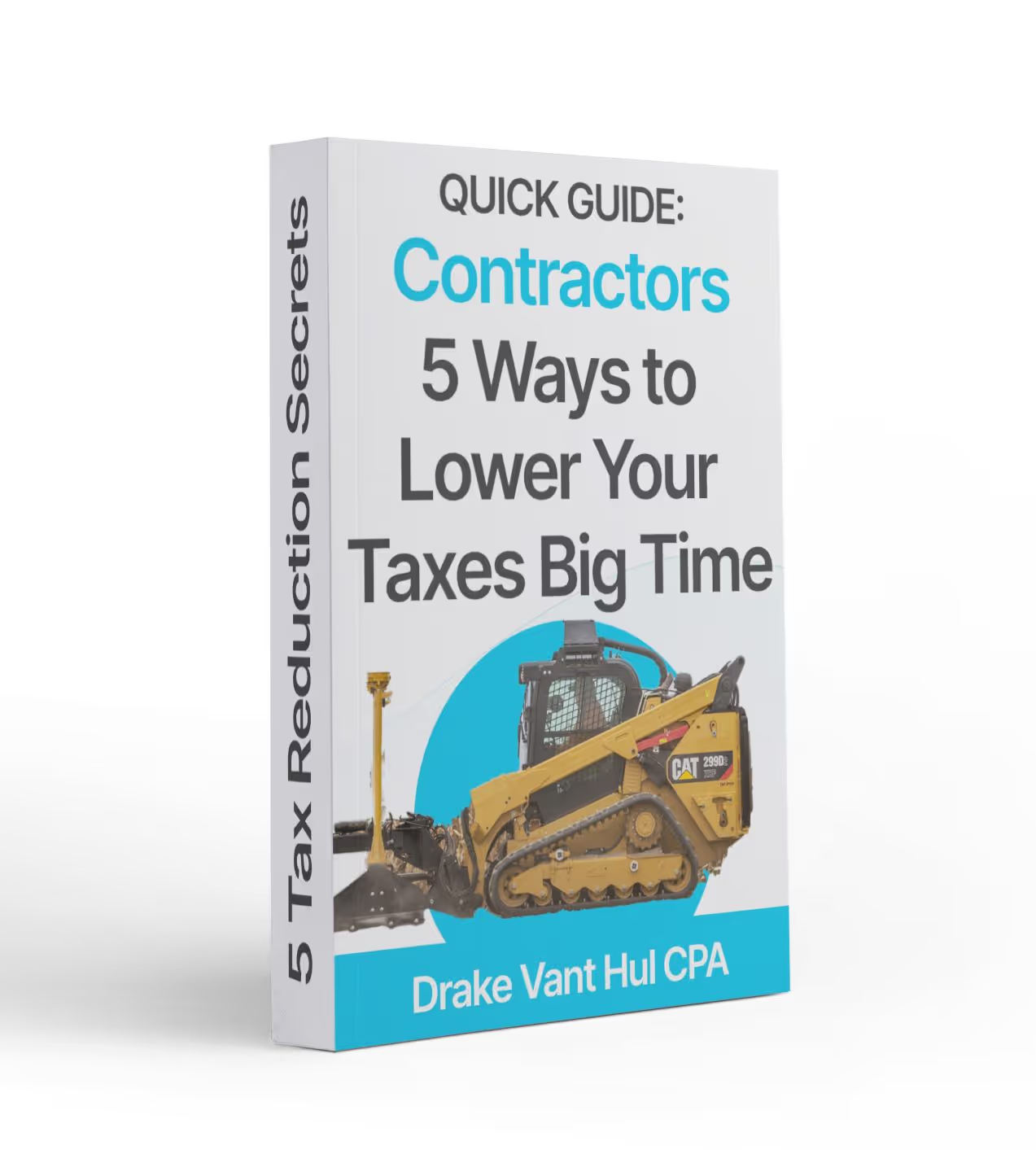
Book a Tax Reduction Analysis today — we'll come prepared with specific savings opportunities based on your situation. You can also check out our client reviews, visit our contractor services page, or download our free guide: 5 Ways to Reduce Contractor Taxes.
Additional Resources for Iowa Roofing Contractors
Schedule a Tax & Accounting Analysis Now
Step 1 - Fill out the form below.
Step 2 - Select a time.
Step 3 - Provide documents.