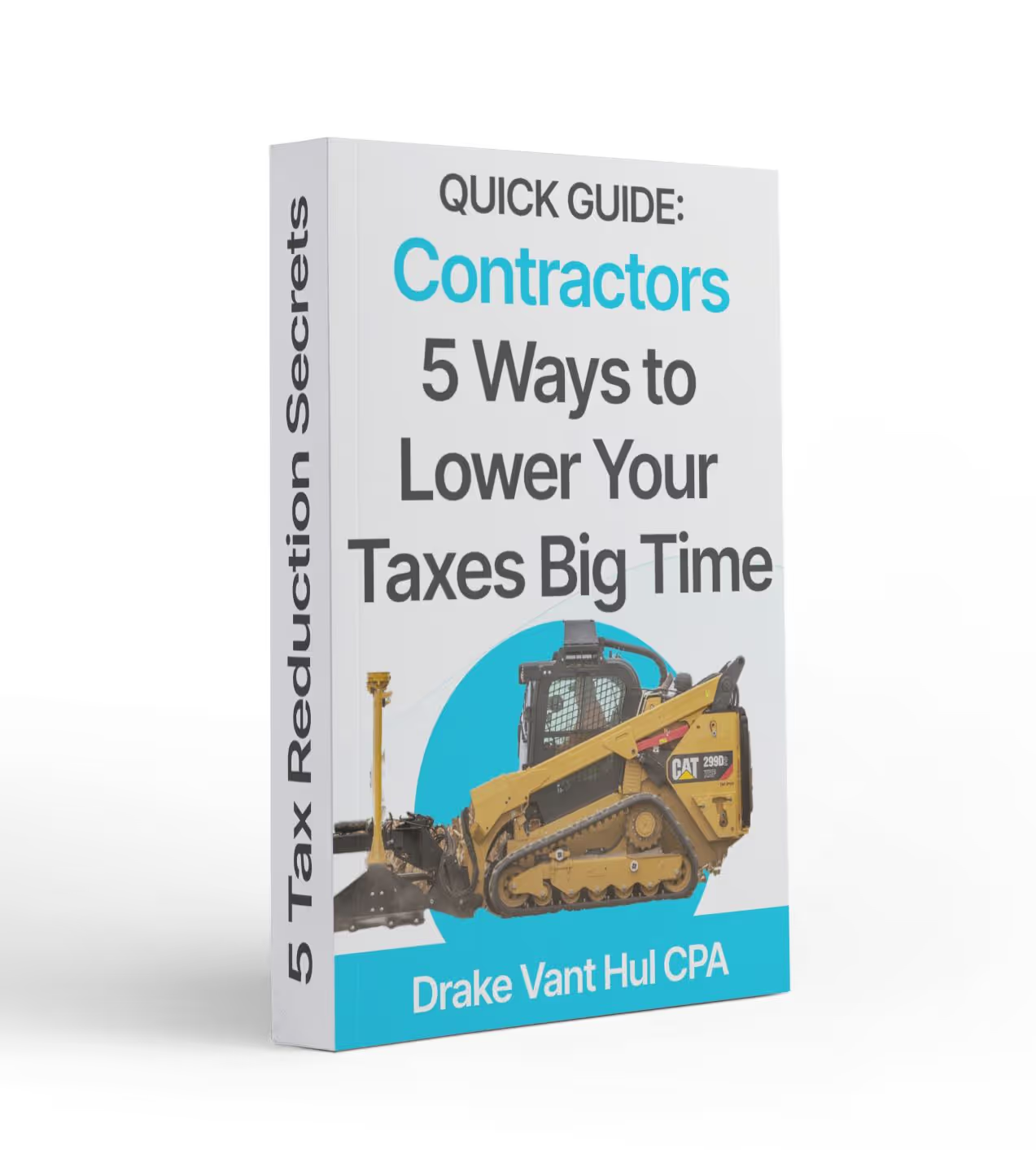
A complete playbook for general contractors, builders, and trade businesses across Des Moines and Iowa who are tired of overpaying the IRS and guessing at their numbers.
Most contractors are exceptional at their craft and underserved by their accountant. They build, remodel, pour, paint, and wire all year, then hand a shoebox of records to a tax preparer who files a return and disappears until next April. That gap between what a contractor earns and what a contractor keeps is enormous, and it is almost entirely avoidable.
We are Performance Financial, an outsourced accounting firm in the Des Moines area that works specifically with general contractors and builders across Iowa. We wrote this guide to teach you the nine strategies that separate contractors who quietly build wealth from contractors who quietly overpay. None of this is legal or tax advice for your specific situation, and every business is different, so treat this as an education and then talk to a professional about your numbers.
Here is what most Iowa contractors are leaving on the table.
#1 Contractor Tax Strategy: Electing and Maximizing an S-Corporation
If you are running your contracting business as a sole proprietorship or a standard LLC and clearing real profit, this is almost certainly the single most expensive mistake on your return.
In a Schedule C or default LLC, every dollar of net profit gets hit with self-employment tax of 15.3 percent on top of your regular income tax. By electing S-Corp status, you pay yourself a reasonable salary that is subject to that tax, and the remaining profit comes out as distributions that are not. For a contractor netting solid six figures, the swing is commonly five figures a year.
The mechanism is the IRS S-Corporation election via Form 2553, and the catch is that the IRS requires a reasonable salary before distributions. Set the salary wrong and you either overpay tax or invite scrutiny. This is exactly the kind of analysis we run for contractors, and it is not a one-time switch. It needs payroll set up correctly and revisited as your profit grows.
A Des Moines remodeler clearing $180,000 in profit as an LLC could be overpaying by $12,000 or more annually simply because nobody ran this analysis. That is a truck payment, a hire, or a retirement contribution, handed to the IRS for no reason.
This is the first thing we look at in a Tax and Accounting Analysis.
#2: Bonus Depreciation and Section 179 on Equipment
Contractors buy trucks, trailers, tools, and heavy equipment. Used correctly, those purchases are some of the most powerful tax tools available. Used carelessly, the deductions get missed or misapplied.
Section 179 expensing lets you deduct the full cost of qualifying equipment in the year you buy it, rather than depreciating it over years. Bonus depreciation works alongside it. The timing of a purchase, whether you buy in December or January, can move thousands of dollars of tax from one year to the next, which matters enormously when you are managing cash.
The mistake is treating equipment purchases as a year-end scramble instead of a planned strategy. A contractor who buys a $70,000 work truck without coordinating the timing and method with their accountant often captures far less benefit than one who planned it. Proactive planning here is the entire point of having a real accountant rather than a once-a-year preparer.
#3: Job Costing as a Profit Strategy, Not Just Bookkeeping
This is where contracting differs from every other small business, and where generic accountants fail contractors most often.
Job costing assigns every labor hour, material receipt, subcontractor invoice, and equipment cost to a specific project. Without it, you see one lump of revenue and one lump of expense, and you have no idea which jobs make money. With it, you discover that your repaint work runs 30 percent margins while your new construction barely breaks even, or vice versa, and you start bidding and chasing the work that actually pays.
Job costing is not a tax strategy on its surface, but it drives every profit decision you make. The contractors we work with who adopt real job costing routinely find they have been underpricing an entire category of work for years. Fixing that is worth more than most tax moves.
A great public example of a contractor obsessed with operational excellence is Cascade Concrete Coatings, whose focus on systematized, repeatable installs is exactly the kind of operation that benefits from job-level financial tracking. When the work is systematized, the books should be too.
#4: Retirement Plans That Double as Tax Reductions
Most contractors think of retirement as something to deal with later. The tax code rewards the ones who deal with it now.
A SEP-IRA or a Solo 401(k) lets a profitable contractor move large sums into tax-advantaged retirement savings while reducing this year's taxable income. The IRS retirement plan options for the self-employed allow contributions far larger than a standard IRA. For a contractor having a strong year, this is one of the cleanest ways to cut a tax bill while building real wealth.
The strategy compounds with the S-Corp structure, because your plan options and contribution math change once you are paying yourself a salary. This is why these strategies should be planned together, not in isolation.
#5: Hiring Your Kids the Right Way
If you have children and a legitimately structured business, paying them for real work they actually do can shift income from your high tax bracket to their very low one, and in the right structure, that wage can be free of certain payroll taxes.
The IRS rules on family employment are specific. The work has to be real, the pay has to be reasonable, and the documentation has to be clean. Done sloppily, it is a liability. Done correctly, it is a legitimate, time-tested way to lower the family tax bill and start your kids on earned-income retirement savings.
This is a strategy that rewards a contractor who has a real accountant keeping the records straight, and punishes the one who improvises it.
#6: The Accountable Plan and Home Office
Contractors run trucks, use part of their home for the business, and cover countless small costs out of pocket. An accountable plan is the structure that lets an S-Corp reimburse you for those business expenses, including a legitimate home office, in a tax-efficient way.
Most contractors either skip the home office deduction out of an outdated fear of audits, or claim it incorrectly. The IRS home office rules are clear, and for a contractor who genuinely runs the administrative side of the business from home, this is money being left behind every year.
These are not glamorous strategies, but stacked together across a year they add up to real savings, and they are exactly the kind of detail a reactive tax preparer never bothers to set up.
#7: Proactive Quarterly Tax Planning Instead of April Surprises
Here is the difference between an amateur arrangement and a real one. An amateur accountant tells you what you owe in April. A real accountant meets you through the year, projects your liability, and implements strategy before the year closes.
The single most common complaint we hear from contractors who switch to us is that their previous accountant was reactive, hard to reach, and full of surprises. A surprise five-figure tax bill is not just unpleasant, it is a cash flow event that can stall jobs and payroll.
Proactive quarterly planning means you make estimated payments with confidence, you time equipment and retirement moves deliberately, and you never get ambushed. This is the core of what an outsourced accounting relationship delivers that a once-a-year preparer cannot. A peer firm that models this proactive approach well is Passageway Financial, an outsourced accounting firm in the Twin Cities focused on contractors and home services businesses. We respect their model because it mirrors our own conviction that contractors deserve a year-round partner, not an April transaction.
#8: Building a Business Lenders and Bonding Companies Trust
Growth-minded contractors eventually need a line of credit, a larger bond, or financing for equipment and expansion. Every one of those depends on clean, credible financials.
When your books are a mess, lenders see risk and price it accordingly, or decline you. When your financials are pristine, with proper work-in-progress reporting and accurate job costing, you become the contractor banks want to lend to and the one bonding companies extend further. That access to capital is often the difference between staying stuck at your current size and breaking through to the next level.
This is a strategy that pays off invisibly for years and then decisively at the moment you need to grow. The contractors who plan for it win the bigger jobs.
#9: Treating Your Accounting System as an Investment, Not an Expense
The cheapest bookkeeping is the most expensive thing a growing contractor can buy. A part-time bookkeeper who enters transactions but cannot build job costing, forecast cash, or plan taxes leaves all nine of these strategies on the table.
As Drake Vant Hul, our founder, frames it for contractors weighing the cost of real accounting: instead of buying a truck that makes you $100,000 this year, buy the financial system that makes you a million over the next five. The outsourced accounting model gives a contractor the full outcome of an in-house accountant and bookkeeper, at a fraction of the cost of a salaried hire, and from a team that already understands construction.
That is the whole philosophy behind Performance Financial. We exist to help contractors and small business owners across Iowa keep more of what they earn, run on clean books, and stay focused on the work they are great at.
How to Put These Strategies to Work
You do not implement all nine at once. Here is a sane order.
Start with the structural and highest-impact moves: get the S-Corp analysis done and your entity structured correctly, then build real job costing so you actually know your numbers. Next, layer in the planned strategies: equipment timing, retirement contributions, family employment, and the accountable plan. Then make proactive quarterly planning your normal rhythm so nothing is ever a surprise. Finally, use the clean financials you have built to access the capital that fuels your growth.
That sequence turns a contractor who overpays and guesses into one who keeps more, knows their margins, and grows on purpose.
Frequently Asked Questions
What is the biggest tax write-off for contractors?
The biggest tax move for most profitable contractors is not a deduction at all, it is electing and properly running an S-Corporation, which can save five figures a year in self-employment tax. After that, equipment expensing under Section 179 and retirement plan contributions are typically the largest levers.
When should a contractor switch from an LLC to an S-Corp?
There is no single threshold, but contractors clearing roughly $60,000 to $80,000 or more in profit are usually overpaying as a default LLC. The right answer depends on your salary requirements and overall picture, which is why it should be analyzed rather than guessed.
Why do contractors need a specialized accountant instead of a regular one?
Construction involves job costing, retention, work-in-progress reporting, equipment depreciation, and specific income recognition rules that generic accountants are not built for. A contractor with the wrong accountant overpays taxes and bids blind on profitability.
How much can proactive tax planning actually save a contractor?
It varies widely, but stacking the strategies in this guide commonly saves contractors tens of thousands of dollars a year compared to a reactive, once-a-year tax preparer. The exact figure depends on your profit, structure, and how aggressively the strategies are implemented.
Does Performance Financial only work with Des Moines contractors?
No. Performance Financial serves contractors throughout the Des Moines metro including Waukee, Ankeny, West Des Moines, and Pella, as well as across Iowa and the broader Midwest.
You have just read what your accountant should have been telling you all along. Book a Tax and Accounting Analysis with Performance Financial and we will examine your tax returns and books, then show you every legal way to reduce your taxes, clean up your financials, and build a contracting business that keeps more of what it earns.
Performance Financial CPA, Tax and Accounting is an outsourced accounting firm serving contractors, builders, and small business owners across Des Moines, Iowa, and the Midwest. This article is educational and not specific tax or legal advice. Every business is different, and results vary with your circumstances, including QBI and other factors. Consult a professional about your situation.
Schedule a Tax & Accounting Analysis Now
Step 1 - Fill out the form below.
Step 2 - Select a time.
Step 3 - Provide documents.